Guide
Cooking Temperature: The Internal Numbers That Actually Matter
Ad links. We may earn a commission on purchases, at no extra cost to you.
"Cooking temperature" is used for two different numbers, and only one of them tells you whether food is done. The first is the heat you apply — an oven set to 180 °C (350 °F), oil held at 175 °C (350 °F), a pan on high. The second is the internal temperature at the centre of the food, and that is the number that decides both safety and texture. The widely used internal targets are 74 °C (165 °F) for poultry and reheated leftovers, 71 °C (160 °F) for ground meats, 63 °C (145 °F) followed by a three-minute rest for whole cuts of beef, pork, veal and lamb, and 63 °C (145 °F) for fish. Everything else on this page is about when those numbers apply, when a higher number gives a better result, and how to read them so they mean something.
The two numbers people call "cooking temperature"
Applied heat and internal temperature are related but not interchangeable. A chicken thigh in a 200 °C (400 °F) oven never reaches 200 °C — water in the meat absorbs energy as it evaporates, and the centre climbs slowly toward the point where cooking stops it. Raising the oven setting changes how fast the centre gets there and how much of a browned, dried outer layer forms on the way, not where it ends up.
That is why recipe times are a rough guide and internal temperature is the actual measurement. Two chicken breasts of the same weight can differ by ten minutes because one is thicker, colder from the fridge, or sitting on a crowded tray. Our assessment is that a reader who owns one instant-read thermometer and ignores clock times will get more consistent results than a reader who follows times precisely without one.
There is also a temperature range worth avoiding rather than hitting. Roughly between 4 °C and 60 °C (40 °F and 140 °F), bacteria multiply quickly, so the goal with cold food is to keep it below that band, with hot food to keep it above, and with cooking to move through it rather than park in it.
- Applied heat: oven, pan, grill or oil setting — controls speed and surface browning
- Internal temperature: the centre of the food — controls safety and doneness
- Time: an estimate that follows from the other two, not an input you can trust alone
Internal temperatures that decide safety
Whole cuts of muscle are essentially sterile inside; contamination lives on the surface, which is why a seared steak can be pink in the middle. Grinding mixes surface bacteria throughout, so minced and ground meat needs a higher internal number all the way through. Poultry is treated as a higher-risk category regardless of cut.
The commonly cited safe targets below are instant readings — the moment the thermometer shows the number, that point in the food is done. The three-minute rest attached to whole cuts is not decoration: the temperature holds or rises slightly during it, and that continued time at heat is part of the guidance.
- Poultry, whole or in pieces, and ground poultry: 74 °C (165 °F)
- Ground beef, pork, veal and lamb: 71 °C (160 °F)
- Whole cuts of beef, pork, veal and lamb: 63 °C (145 °F), then rest three minutes
- Fish and shellfish: 63 °C (145 °F), until flesh is opaque and separates easily
- Egg dishes such as casseroles and quiche: 71 °C (160 °F)
- Leftovers and reheated food: 74 °C (165 °F) throughout, not just at the edges
Doneness temperatures for steaks, roasts and chops
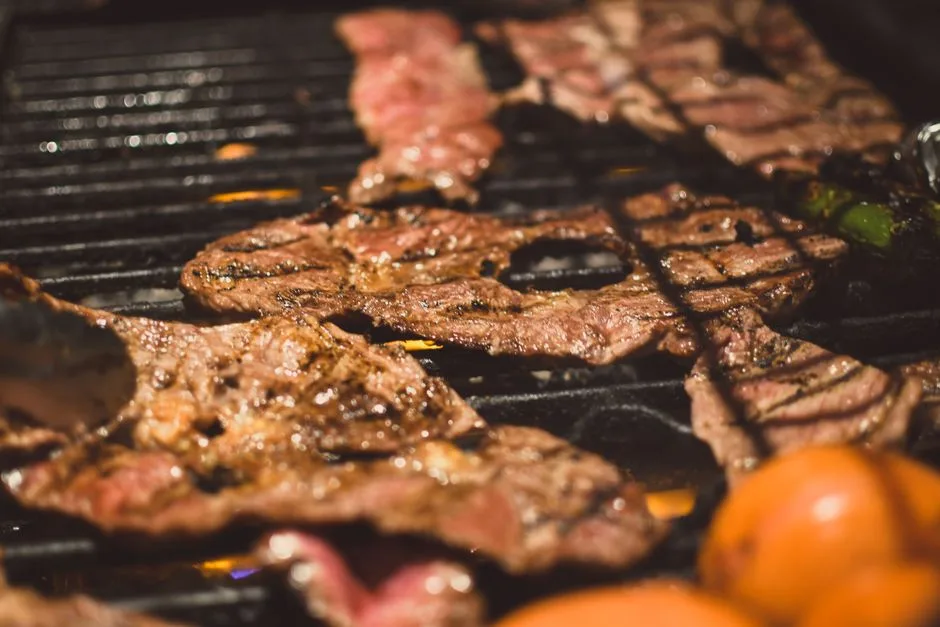
Above the safety floor, internal temperature becomes a texture control. Muscle proteins contract in stages as they heat, squeezing out moisture, so every degree past your preferred doneness costs juiciness. The ranges below are the ones cooks generally use for beef and lamb, measured at the thickest part.
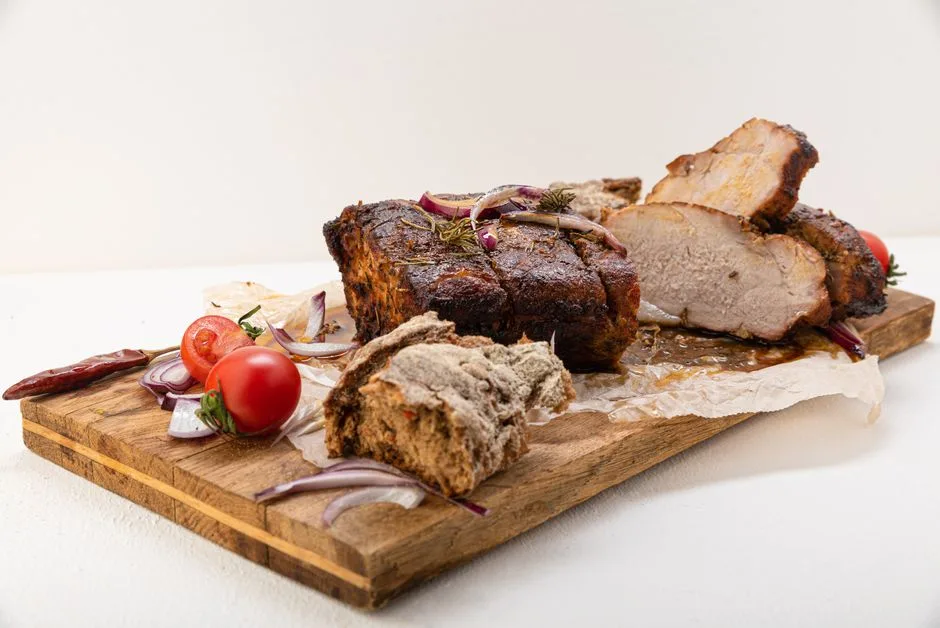
Pull the food off the heat below your target. Heat already in the outer layers keeps moving inward after cooking stops, and the centre continues to climb — commonly a couple of degrees for a thin steak and considerably more for a large roast, where the effect can run to 5 °C (10 °F) or beyond. A roast pulled at exactly the number you wanted will overshoot it while it rests.
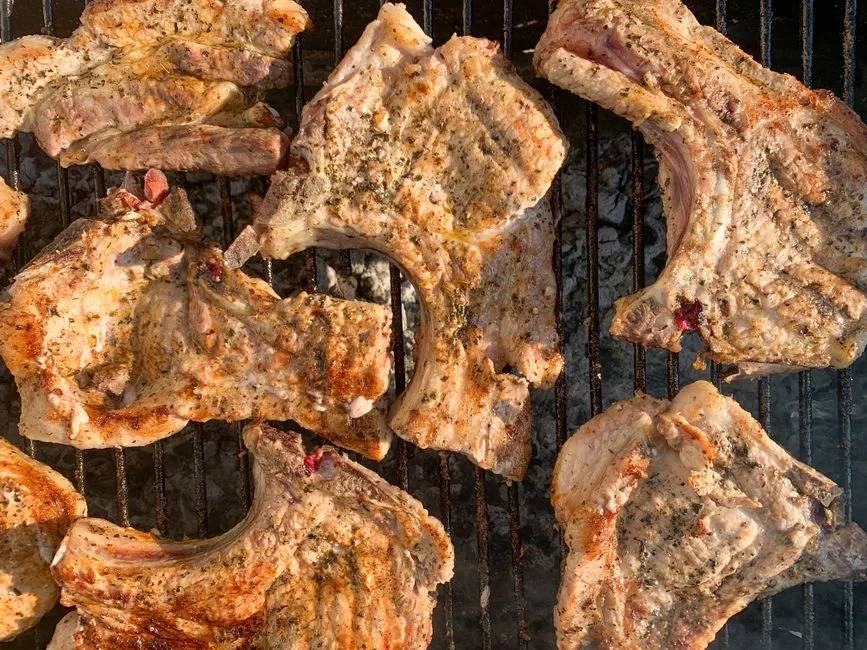
Pork chops and loin follow the same logic. Cooked to 63 °C (145 °F) and rested, they stay faintly pink and remain tender; taken to the well-done temperatures older habits call for, the same cut turns dry and fibrous.
- Rare: about 52 °C (125 °F)
- Medium rare: about 54–57 °C (130–135 °F)
- Medium: about 57–63 °C (135–145 °F)
- Medium well: about 63–68 °C (145–155 °F)
- Well done: 68 °C (155 °F) and above
- Rest large roasts 15–20 minutes; a steak needs only a few
When higher than "done" is the right answer
Some cuts are technically safe long before they are pleasant to eat. Brisket, pork shoulder, short ribs, oxtail and chicken legs are dense with connective tissue, and the collagen in that tissue only breaks down into gelatin after an extended stretch at high internal temperatures. Pulling pork shoulder at 63 °C (145 °F) gives you a safe piece of meat that is tough and chewy.
For these cuts, cooks generally aim for the 90–96 °C (195–205 °F) range and judge the end by feel as much as by number — a probe should slide in with almost no resistance. The internal temperature will appear to stall for a long period around 65–75 °C (150–165 °F) as evaporation cools the surface as fast as the heat goes in; this is normal and waiting it out is part of the method.
Chicken thighs and drumsticks benefit from the same principle on a smaller scale. They are safe at 74 °C (165 °F) but the texture usually improves at 75–85 °C (170–185 °F), where the connective tissue softens without the leanness penalty that would ruin a breast.
- Collagen-rich cuts: 90–96 °C (195–205 °F), probe should meet no resistance
- Chicken dark meat: safe at 74 °C (165 °F), often better nearer 80 °C (175 °F)
- Lean poultry breast: stop at 74 °C (165 °F) — there is no textural gain above it
Oven, pan and oil temperatures
The applied-heat side of the question has fewer hard rules and more trade-offs. Low oven settings, roughly 120–150 °C (250–300 °F), heat food evenly and produce a thin band of overcooked meat under the surface, which is why they suit large roasts. High settings, 200–230 °C (400–450 °F), drive browning and crisp skin but widen that overcooked band. Many roasting methods combine the two, using one for the bulk of the cooking and the other for a short blast at either end.
Deep frying generally runs between 160 °C and 190 °C (325–375 °F). Below that range, food absorbs oil instead of sealing; above it, the outside colours before the inside cooks and the oil degrades faster. Oil temperature drops sharply the moment food goes in, so frying in small batches keeps it in range.
Home ovens are frequently inaccurate, and the dial is not evidence. An oven thermometer left on the middle rack will tell you whether your 180 °C is actually 165 °C or 200 °C — a discrepancy that explains a great many baking failures without any change to the recipe.
- Low roasting: 120–150 °C (250–300 °F) — even cooking, little browning
- Standard roasting and baking: 175–190 °C (350–375 °F)
- High roasting: 200–230 °C (400–450 °F) — browning, crisp skin, less evenness
- Deep frying: 160–190 °C (325–375 °F), maintained by frying in batches
- Bread: lean loaves are usually taken to around 93–99 °C (200–210 °F) internal, enriched doughs to around 88–91 °C (190–195 °F)
Reading the thermometer so the number means something
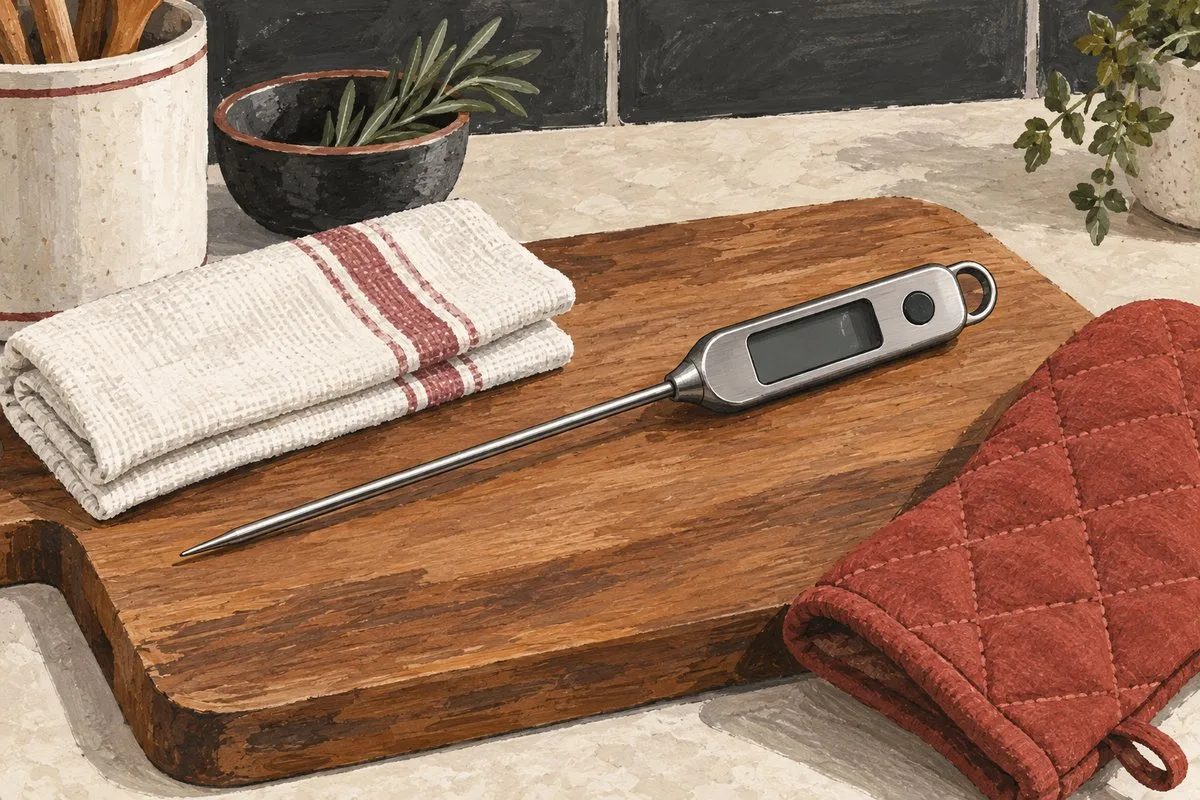
A thermometer reports the temperature of one small point, so placement is most of the accuracy. Aim for the thickest part of the food, away from bone, fat pockets and any pan surface, and approach from the side of a thin cut rather than the top so the tip sits in the centre rather than passing through it. On a whole bird, the deepest part of the breast and the thickest part of the thigh give different readings and both are worth taking.
Check more than one spot on anything large or irregularly shaped. The lowest reading is the one that counts, because that is the part still catching up. If two probes into the same roast differ by several degrees, the roast is not done — it is uneven.
Thermometers drift. Two fixed points let you check one without any equipment: a well-stirred slurry of crushed ice and water sits at 0 °C (32 °F), and water at a rolling boil sits at 100 °C (212 °F) at sea level, lower at altitude. A device reading several degrees off at those points is reading several degrees off in your dinner. Leave-in probes and instant-reads are worth checking occasionally; pop-up indicators built into poultry are not a substitute for either.
One more habit matters as much as the reading itself. Wash the probe between uses, especially after it has been in raw meat, so it does not carry surface bacteria into food that is already cooked.
- Probe the thickest part, avoiding bone, fat and the pan
- Enter thin cuts from the side, not the top
- Take several readings on roasts and whole birds; trust the lowest
- Calibrate against ice water at 0 °C (32 °F) and boiling water at 100 °C (212 °F)
- Clean the probe between checks
Frequently Asked Questions
Does all chicken really have to reach 74 °C (165 °F)?
74 °C (165 °F) is the temperature at which the relevant reduction in bacteria happens effectively instantly, which is why it is the standard single-number guidance. Pasteurisation is actually a combination of temperature and time, so lower internal temperatures can achieve the same result if the meat is held there long enough — at around 60 °C (140 °F) the required hold runs into tens of minutes rather than seconds. Holding a precise low temperature for that long needs equipment and control that most kitchens do not have, so for ordinary roasting, frying and grilling, 74 °C (165 °F) remains the practical target.
What temperature should I pull a steak off the heat for medium rare?
Aim to remove it a few degrees below your target, around 51–54 °C (124–130 °F) for a medium-rare finish near 54–57 °C (130–135 °F). Carryover cooking pushes the centre up while it rests. The gap depends on thickness and how hot the surface got: a thin steak from a moderate pan may rise only a degree or two, while a thick steak seared hard can climb noticeably more.
Why is my pork shoulder tough even though the thermometer says it is done?
Because "safe" and "tender" are different temperatures for that cut. Pork shoulder is full of connective tissue that needs an extended period at high internal temperatures to break down into gelatin, generally in the 90–96 °C (195–205 °F) range. At 63 °C (145 °F) it is perfectly safe to eat and still tough. The same applies to brisket, short ribs and other hard-working muscles.
Can I go by cooking time instead of temperature?
Time is a useful estimate for planning but a poor test of doneness. It depends on the thickness and starting temperature of the food, how crowded the pan is, how accurate the oven is and how often the door is opened. Two pieces of the same weight can finish minutes apart. Use the clock to know when to start checking, and the thermometer to decide when to stop.
What internal temperature should fish be cooked to?
The general guidance figure is 63 °C (145 °F), at which point the flesh is opaque and flakes apart easily. Many cooks prefer salmon and tuna noticeably rarer than that, in the region of 49–54 °C (120–130 °F), for a softer texture. That is a personal risk decision rather than a food-safety one, and it depends on the quality and handling of the fish; the higher figure is the conservative choice.
Related guides