Guide
Pork Loin Internal Temperature: The Complete Guide for Roasts and Chops
This page contains affiliate links – if you buy through them we may earn a commission, at no extra cost to you. The recommendations are our own assessment. As an Amazon Associate we earn from qualifying purchases.
Pork loin is one of the leanest cuts available, which makes hitting the right internal temperature essential. Cook it too little and food safety becomes a concern; cook it too far and you end up with dry, chalky meat. The USDA updated its pork guidelines in 2011, lowering the recommended minimum from 71 °C (160 °F) to 63 °C (145 °F) followed by a three-minute rest. This guide explains what that means in practice for both roasts and chops, how carryover cooking affects your final temperature, and how to use an instant-read thermometer to get consistent results every time.
USDA Recommended Internal Temperatures for Pork Loin
The USDA recommends cooking all whole-muscle pork cuts — including loin roasts and chops — to a minimum internal temperature of 63 °C (145 °F), measured at the thickest part of the meat, followed by a three-minute rest before carving or serving. Ground pork has a higher target of 71 °C (160 °F) because bacteria can be mixed throughout during processing.
At 63 °C the centre of the pork will look faintly pink. This is normal and safe. The old recommendation of 71 °C was revised because modern farming and inspection practices have significantly reduced the risk of trichinosis, which was the original reason for the higher target.
- Pork loin roast: 63 °C (145 °F) with a 3-minute rest
- Pork loin chops: 63 °C (145 °F) with a 3-minute rest
- Ground pork (burgers, meatballs): 71 °C (160 °F), no rest required
- A faint pink centre at 63 °C is safe and indicates juicy, properly cooked pork
Why Carryover Cooking Matters
When you remove pork from the heat source, its internal temperature continues to rise. This is called carryover cooking, and it happens because the outer layers of the meat are significantly hotter than the centre. Heat energy continues flowing inward even after the meat leaves the oven or grill.
For a thick pork loin roast, carryover can add 3–5 °C (5–10 °F) to the final internal temperature. For thinner chops, the effect is smaller — typically 1–2 °C (2–4 °F). That is a reason to start checking early, not a reason to take the meat out early: the centre still has to read 63 °C (145 °F) before it leaves the heat. Carryover then carries it a few degrees past the floor while it rests.
- Pork loin roast: cook until the centre reads 63 °C (145 °F) before it leaves the oven, then rest 3 minutes
- Thick-cut chops (3 cm / 1.2 in or more): cook until the centre reads 63 °C (145 °F), then rest 3 minutes
- Thin-cut chops (under 2 cm / 0.8 in): carryover is minimal, so cook to the full 63 °C (145 °F) before removing
- Higher oven or grill temperatures create a steeper heat gradient and increase carryover
How to Measure Temperature Accurately
An instant-read digital thermometer is the single most useful tool for cooking pork loin. Visual cues like colour and firmness are unreliable — pork can look done on the outside while still being undercooked in the centre, or look pink and yet be fully safe.
Insert the probe into the thickest part of the meat, avoiding contact with bone, fat pockets, or the pan surface. For a roast, this is typically the geometric centre. For a chop, insert the probe horizontally through the side into the middle of the thickest section.
- Use a digital instant-read thermometer rather than relying on colour or touch
- For roasts, insert the probe into the geometric centre of the thickest portion
- For chops, insert horizontally through the side to reach the middle
- Avoid touching bone — bone conducts heat differently and gives a misleading reading
- Leave-in probe thermometers are useful for roasts because you can monitor temperature without opening the oven
Pork Loin Roast: Temperature and Technique
A bone-in or boneless pork loin roast typically weighs between 1 and 2.5 kg (2–5 lb). Because of its size and cylindrical shape, it benefits from moderate oven heat — around 180 °C (350 °F) — which allows the centre to come up to temperature without the outside drying out.
Searing the roast in a hot pan before transferring to the oven creates a flavourful crust without significantly affecting cook time. Whether you sear first or not, the thermometer is what determines doneness, not time per kilogram. Oven temperatures vary, and the shape and starting temperature of the roast all affect how quickly it cooks.
- Bring the roast to room temperature for 30–45 minutes before cooking for more even results
- A moderate oven of 180 °C (350 °F) works well for even cooking throughout
- Remove from the oven once the centre reads 63 °C (145 °F), then tent loosely with foil
- Rest for at least 3 minutes (10 is better for slicing) — carryover will carry it a few degrees past 63 °C (145 °F)
- Resting also allows juices to redistribute, reducing moisture loss when you slice
Pork Loin Chops: Temperature and Technique
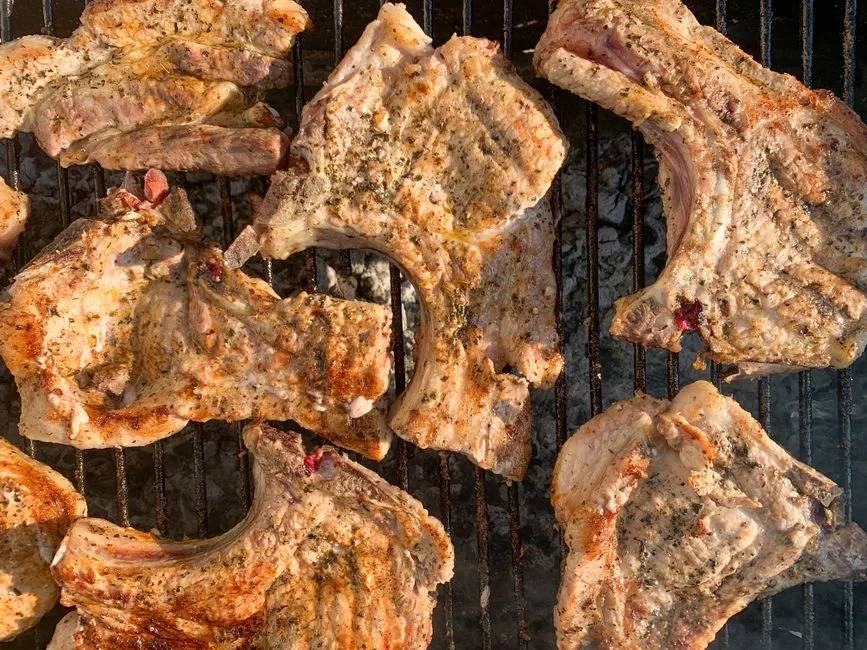
Chops cook much faster than roasts, which means the margin for error is smaller. A 2.5 cm (1 in) chop on a medium-high pan or grill can go from perfectly done to overcooked in under two minutes. This is where a thermometer saves the meal.
For pan-searing, heat the pan until a drop of water sizzles immediately. Cook the chop for 3–4 minutes per side without moving it, then check the internal temperature. For grilling, use direct heat and flip once. In both cases, cook the chops until the centre reads at least 63 °C (145 °F), then rest them for three minutes.
- Pat chops dry before cooking — surface moisture prevents browning
- Cook over medium-high heat for a good sear without burning
- Flip once and avoid pressing down on the chop, which squeezes out juice
- Cook until the centre reads 63 °C (145 °F), then remove and rest for 3 minutes
- Brining chops in a simple salt-water solution for 30 minutes to 2 hours improves moisture retention
Resting: Why It Is Not Optional
The USDA's 145 °F guideline explicitly includes a three-minute rest period. During this time, residual heat continues to eliminate pathogens, and the temperature stabilises throughout the cut. Skipping the rest means the interior may not have reached a safe temperature for long enough.
Resting also has a culinary benefit. When meat is hot from cooking, the muscle fibres are contracted and the juices inside are under pressure. If you cut immediately, those juices run out onto the cutting board. Resting allows the fibres to relax and reabsorb moisture, producing noticeably juicier meat.
- Minimum 3 minutes rest for food safety, as specified by the USDA
- Roasts benefit from 10–15 minutes of rest, tented loosely with foil
- Chops need only 3–5 minutes
- Do not wrap tightly in foil — trapped steam softens the crust
Common Mistakes That Lead to Dry Pork Loin
Pork loin is lean by nature — it has far less intramuscular fat than shoulder or belly. That leanness is what makes it appealing for many cooks, but it also means there is very little fat to mask overcooking. Even 5 °C above the ideal target can produce a noticeably drier result.
- Cooking to the old 71 °C (160 °F) target — this is no longer recommended and produces dry meat
- Relying on cooking time alone instead of measuring temperature
- Using too high an oven temperature, which dries the surface before the centre is done
- Skipping the rest period, which causes juice loss and may leave the centre undercooked
- Cutting into the meat to check doneness — this releases juices and is less accurate than a thermometer
Temperature Preferences Beyond the Minimum
While 63 °C (145 °F) is the USDA minimum, some cooks prefer their pork slightly more done. Personal preference is valid as long as you are above the safety floor. Here is a rough guide to how pork loin behaves at different final temperatures.
- 63 °C (145 °F): juicy, faintly pink centre — maximum moisture retention
- 66 °C (150 °F): very slight pink, still moist — a good middle ground for those uneasy with pink pork
- 71 °C (160 °F): no pink, noticeably firmer — works if you brine or sauce the meat generously
- Above 74 °C (165 °F): dry and chalky for loin cuts — this range is better suited to fattier cuts like shoulder
Frequently Asked Questions
Is pink pork loin safe to eat?
Yes. Pork cooked to 63 °C (145 °F) with a three-minute rest is safe according to the USDA, even if the centre appears faintly pink. Colour alone is not a reliable indicator of doneness — temperature is.
What is the difference between pork loin and pork tenderloin?
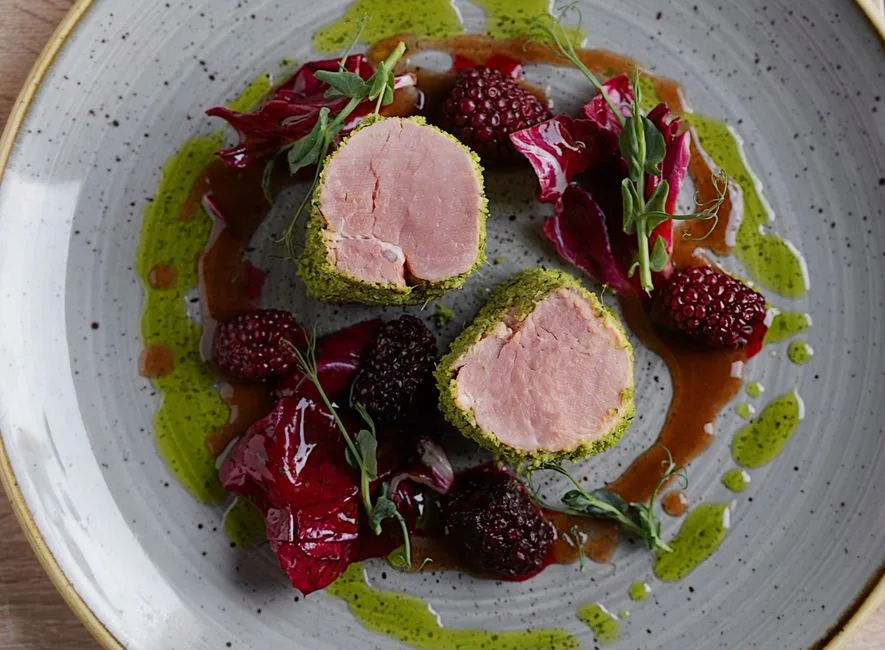
Pork loin is a wide, thick cut from along the back of the pig, sold as roasts or cut into chops. Pork tenderloin is a much smaller, narrower muscle that sits beneath the loin. Both are lean, but tenderloin is more tender and cooks significantly faster. The same 63 °C (145 °F) target applies to both.
Should I use a leave-in probe or an instant-read thermometer?
For roasts, a leave-in probe thermometer is convenient because you can monitor the temperature without opening the oven. For chops, an instant-read thermometer is more practical since the cook time is short. Either type works as long as the probe is positioned in the thickest part of the meat.
How long should I rest a pork loin roast?
Rest a pork loin roast for at least 3 minutes — the USDA rest for whole-muscle pork — and 10 to 15 minutes if you want cleaner slices. That rest starts once the centre has already read 63 °C (145 °F) coming off the heat; it is not how you get there. The temperature drifts up a few degrees while it rests and the juices redistribute for a moister result.
Does brining help prevent dry pork loin?
Yes. A basic brine of roughly 40 g (3 tablespoons) of salt per litre (quart) of water, applied for 1–4 hours depending on thickness, helps the meat retain moisture during cooking. This is especially effective for chops and lean boneless roasts that have no fat cap.
Can I cook pork loin from frozen?
You can, but it is not ideal. Cooking from frozen increases the total cook time by roughly 50 percent and makes it harder to get even results. The exterior may overcook before the centre reaches a safe temperature. Thawing in the refrigerator overnight produces a better result.
Source for every safe minimum temperature on this page: the USDA Food Safety and Inspection Service safe minimum internal temperature chart, https://www.fsis.usda.gov/food-safety/safe-food-handling-and-preparation/food-safety-basics/safe-temperature-chart . Doneness temperatures above the safe minimum are a matter of preference, not safety.
Related guides