Guide
Chicken Internal Temperature: Safe Temp & Where to Check
Almost every question about cooking chicken well collapses into one question: is it done? Colour, clear juices and minutes-per-pound charts all fail often enough to be dangerous, and the only reliable answer is a temperature reading taken in the right place. This guide covers the safe internal temperature published by food safety agencies, why dark meat is often cooked well past it on purpose, exactly where to insert a probe for each cut, and what to look for in a thermometer. Food safety recommendations differ slightly between countries — treat the guidance from your own national food safety authority as the one that governs, and use this as an explanation of the reasoning behind it.
The number: 165°F (74°C)
In the United States, the USDA Food Safety and Inspection Service sets a single minimum internal temperature for all poultry: 165°F (73.9°C), measured with a food thermometer. That figure applies to whole birds, breasts, thighs, wings, ground chicken and any dish containing cooked chicken. Unlike whole cuts of beef, pork, lamb and veal — which carry a three-minute rest requirement — poultry has no mandated rest time at that temperature.
The number is deliberately simple. It is a single, instantaneous target that a home cook can hit without a timer, chosen because it delivers a large safety margin against Salmonella and Campylobacter the moment the thermometer settles. It is not the lowest temperature at which chicken becomes safe; it is the temperature at which it becomes safe immediately.
National targets vary. Health Canada recommends 165°F (74°C) for poultry pieces and a higher 180°F (82°C) for whole birds. UK Food Standards Agency guidance is built around time–temperature combinations, treating something like 70°C held for two minutes as equivalent to a shorter hold at a higher temperature. The underlying microbiology is the same everywhere; the packaging of the advice differs.
- All chicken, all cuts, USDA minimum: 165°F (73.9°C)
- Ground chicken and chicken burgers: same 165°F — grinding spreads surface bacteria through the meat
- Stuffing cooked inside a bird: 165°F in the centre of the stuffing itself
- Leftovers and reheated chicken dishes: 165°F throughout
- The bacterial danger zone: 40–140°F (4–60°C) — minimise time spent there
Why lower temperatures can still be safe (and why 165°F is still the advice)
Pathogen reduction is a function of both temperature and time. Holding chicken at a lower temperature for long enough achieves the same log reduction in Salmonella as a brief moment at 165°F. This is not a loophole — it is the documented basis of commercial poultry processing, and USDA FSIS publishes time–temperature tables (Appendix A of its cooking guidelines) giving the required hold times at each temperature.
This is why sous-vide chicken breast cooked at a lower set temperature for an extended, table-derived time can be both pasteurised and dramatically juicier than the same breast pulled at 165°F. The catch is that it demands a genuinely accurate thermometer, a stable heat source, and a hold measured at the coldest point of the meat rather than the water bath. If you cannot verify all three, the single-number rule is the right rule.
Do not improvise the times from memory or from a forum post. If you want to cook below 165°F, work from the published agency table for chicken, note that the required hold begins only once the centre of the meat has reached the target, and understand that the times differ by fat content and by which version of the table you are reading.
- Pasteurisation is temperature multiplied by time held, not temperature alone
- The hold clock starts when the coldest part of the meat reaches temperature, not when the oven or bath does
- Below-165°F cooking is a technique with prerequisites: calibrated thermometer, stable heat, verified hold
- If any prerequisite is missing, cook to 165°F and accept the drier result
Dark meat: safe at 165°F, better at 175–195°F
Thighs, drumsticks and whole legs are safe at the same 165°F as everything else, but almost nobody who cooks them regularly stops there. Dark meat is dense with connective tissue, and collagen needs sustained heat well above the safety threshold to break down into gelatin. Pulled at 165°F, a thigh is safe but chewy and slightly rubbery.
Most cooks take thighs and drumsticks to somewhere between 175°F and 195°F (80–90°C), where the meat turns tender and the texture becomes silky rather than springy. Dark meat has enough fat and connective tissue to tolerate this without drying out — the same treatment applied to a breast would ruin it.
Breast meat is the opposite problem: it has little collagen and little fat, so every degree past the safety threshold costs moisture. This is the fundamental tension in roasting a whole bird, and it is why the breast and the thigh should be checked separately rather than trusting a single reading.
- Breast: pull at the safety threshold; it only gets drier past it
- Thigh, drumstick, whole leg: 175–195°F (80–90°C) for texture, not safety
- Wings: dark meat, so they also benefit from a higher finish
- Confit, braises and slow-cooked legs run far above these numbers by design
Where to put the probe
Placement is where most temperature readings go wrong. You are looking for the coldest point in the meat — the thermal centre — because that is the last part to become safe. Aim for the thickest section, keep the probe tip away from bone, gristle and the pan surface, and push through until the reading stops falling, then withdraw slowly to find the lowest number.
Bone conducts heat differently from muscle and will read misleadingly high; a probe resting against the roasting pan will read higher still. Fat pockets and air gaps under the skin read low and can send you the other way. Take more than one reading in different spots on anything larger than a single portion.
For thin cutlets and flattened breasts, insert the probe horizontally through the side rather than down from the top — a thin cut simply does not have enough vertical depth to seat the sensor correctly, and most probes measure at a specific point near the tip rather than along the whole shaft.
- Whole bird: innermost part of the thigh, innermost part of the wing, and the thickest part of the breast — check all three
- Bone-in breast: thickest part, angled to avoid the breastbone and ribs
- Boneless breast: through the thickest end, from the side if the cut is thin
- Thighs: into the thickest muscle, clear of the bone
- Ground chicken patties and meatloaf: through the side into the centre
- Rolled or stuffed cuts: centre of the filling as well as the meat
- Clean the probe between checks so it does not carry bacteria from an undercooked spot to a cooked one
Whole birds, stuffing and carryover
A whole roast chicken is an awkward object thermally: the legs sit exposed at the outside, the breast is thick and shielded, and the cavity is an insulating air pocket. The thigh reaches temperature slowest in many birds, which is why it is the standard checkpoint — but it is a checkpoint, not a substitute for reading the breast too.
Stuffing cooked inside the bird is the highest-risk element on the table. It absorbs raw juices, sits in the coldest part of the cavity, and reaches temperature long after the meat around it. It needs its own reading at the centre. Cooking stuffing in a separate dish removes the problem entirely and is the safer default.
Carryover cooking continues after the bird leaves the oven, as residual heat in the outer layers migrates inwards. The effect is small on a single boneless breast and meaningful on a large whole bird, so factor it in when deciding when to pull. Resting also lets juices redistribute, which is a quality benefit rather than a safety requirement for poultry.
- Check thigh, wing joint and breast separately — they finish at different times
- Stuffing needs its own 165°F reading at its centre
- Cooking stuffing outside the bird is safer and easier to control
- Expect carryover rise on large birds; pull accordingly
- Rest for juiciness, not for safety, when cooking poultry to the single-number target
Why colour, juices and timing charts fail
Clear juices are not a doneness test. Juice colour comes largely from myoglobin, and it can run clear well before the meat is safe or stay pink well after — it varies with the bird's age, how the meat was stored, and whether it was frozen. Cutting into the meat to check also releases the moisture you spent the whole cook trying to keep.
Pink meat near the bone is a particularly common false alarm. In young birds the bones are porous and pigment leaches into the surrounding meat during cooking, producing a pink ring in fully cooked chicken. Meat cured or brined with nitrite-containing ingredients can also stay pink at any temperature. Conversely, chicken can look entirely white and still be undercooked in the centre.
Time-per-pound charts are estimates built on assumptions that rarely hold in a home kitchen: starting temperature, whether the bird was fully thawed, oven calibration, how often the door was opened, the pan and rack, and how much air circulates around the meat. Use them to plan when to start checking, never to decide when to stop.
- Clear juices: unreliable in both directions
- Pink near the bone: normal in young birds, not an indicator of undercooking
- White throughout: not proof of a safe centre
- Firmness and the press test: too variable across cuts to trust
- Timing charts: a scheduling tool, not a doneness test
Choosing a thermometer
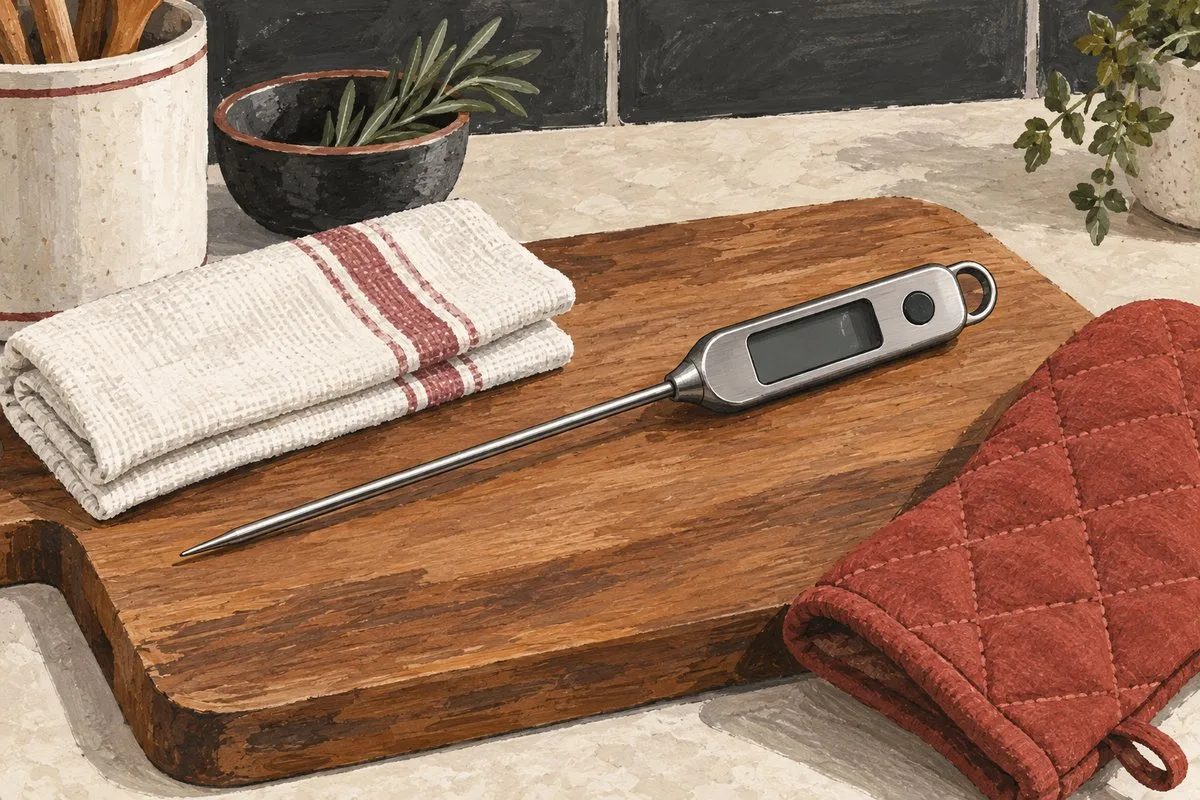
Instant-read digital thermometers are the general-purpose answer. Thermocouple models read fastest and have the finest tips; thermistor models are slower but still practical. Speed matters more than it sounds — a thermometer that takes fifteen seconds to settle means the oven door stays open, and it discourages you from taking the multiple readings that a whole bird needs.
Leave-in probe thermometers with a cable running to an external display are the better tool for long roasts and smoking. They track the curve rather than sampling it, which tells you when to start paying attention. Many cooks use both: a leave-in probe for the trend and an instant-read for spot checks at the finish, since a single fixed probe can only ever monitor one point.
Dial (bimetallic) thermometers measure an average across a section of the stem rather than at the tip, so they need deep insertion — typically a couple of inches — to read correctly, which makes them poorly suited to thin cuts. Infrared thermometers measure surface temperature only and cannot tell you anything about the inside of a piece of chicken. They are the wrong tool for this job entirely.
- Read speed: how many seconds to a stable number, which determines whether you actually check thoroughly
- Stated accuracy: look for a published tolerance rather than an unquantified claim
- Probe tip diameter: thinner tips locate the cold spot more precisely and leave smaller holes
- Water resistance: probes get washed, and steam finds its way into housings
- Calibration: a model you can check and adjust stays trustworthy over years
- Auto-rotating displays and backlights: minor on paper, genuinely useful over a hot oven or grill
- Leave-in probes: check the rated maximum temperature for the cable, not just the probe
Keeping the reading honest
A thermometer is only as good as its calibration, and every thermometer drifts. The ice-water test is the standard check: fill a glass with crushed ice, top with cold water, stir, wait, and insert the probe without touching the sides or bottom. It should read 32°F (0°C). The boiling-water test should read 212°F (100°C) at sea level, but the boiling point drops with altitude, so the ice test is the more portable of the two.
Some thermometers can be recalibrated with a nut under the dial or a menu offset. Others cannot, in which case note the error and apply it mentally — a probe that reads two degrees low is still perfectly usable if you know that it does. Check calibration after any significant drop, and before any cook where the margin matters.
Finally, the reading is one part of a chain. Thaw chicken in the refrigerator, in cold water changed regularly, or in the microwave immediately before cooking — never on the counter. Do not wash raw chicken; rinsing sprays bacteria around the sink and surrounding surfaces without making the meat safer, since cooking is what eliminates the pathogens. Keep raw chicken and its juices away from anything that will not be cooked, wash hands and boards thoroughly, and refrigerate leftovers promptly rather than letting them cool slowly on the stovetop.
- Ice water should read 32°F (0°C); boiling water 212°F (100°C) at sea level, lower at altitude
- Recalibrate where possible; note and mentally correct the offset where not
- Thaw in the refrigerator, in cold water, or in the microwave — never at room temperature
- Do not rinse raw chicken; it spreads contamination without improving safety
- Separate boards and utensils for raw poultry, or wash thoroughly between uses
- Refrigerate leftovers promptly and reheat to 165°F throughout
Frequently Asked Questions
What is the safe internal temperature for chicken?
165°F (73.9°C) measured at the thickest part, according to USDA guidance, and this applies to every cut including ground chicken. Some countries frame it differently — Health Canada recommends 180°F (82°C) for whole birds, and UK guidance uses time–temperature combinations — so follow your national food safety authority.
Is it safe to cook chicken to a lower temperature?
It can be, because pasteurisation depends on both temperature and how long that temperature is held. USDA FSIS publishes time–temperature tables giving the required hold at each temperature. This requires an accurate thermometer, stable heat, and a hold measured from when the centre of the meat reaches the target — not from when the oven does. Without all three, cook to 165°F.
Where exactly should I insert the thermometer in a whole chicken?
Take three readings: the innermost part of the thigh, the innermost part of the wing, and the thickest part of the breast. Keep the tip clear of bone and the roasting pan, both of which read high. Push in until the number stops falling, then withdraw slowly to find the lowest reading.
Why are my chicken thighs still tough at 165°F?
Because 165°F is a safety threshold, not a texture target. Dark meat is full of collagen that needs sustained heat above that point to break down into gelatin. Most cooks take thighs and drumsticks to 175–195°F (80–90°C), where they turn tender rather than rubbery. Dark meat has enough fat to handle it; breast meat does not.
My chicken is pink near the bone but reads 165°F. Is it safe?
Yes. In young birds the bones are porous and pigment leaches into the surrounding meat during cooking, leaving a pink ring in fully cooked chicken. Nitrite-containing brines and cures can also fix a pink colour permanently. Colour is not a doneness indicator in either direction — trust a correctly placed thermometer reading.
Do clear juices mean the chicken is cooked?
No. Juice colour comes mostly from myoglobin and varies with the bird's age, storage and whether it was previously frozen. Juices can run clear before the meat is safe and stay pink after it is. Cutting in to check also drains the moisture you were trying to keep.
What kind of thermometer should I buy?
An instant-read digital thermometer covers most needs — thermocouple models are fastest, thermistor models slower but workable. Add a leave-in probe thermometer if you roast or smoke often, since it tracks the whole curve rather than sampling it. Avoid infrared thermometers for this purpose entirely; they read surface temperature only.
How do I know my thermometer is accurate?
Test it in ice water: crushed ice topped with cold water, stirred, with the probe held clear of the sides and bottom. It should read 32°F (0°C). Boiling water should read 212°F (100°C) at sea level, though that drops with altitude. Some thermometers can be recalibrated; on those that cannot, note the offset and correct for it.
Should I rinse chicken before cooking it?
No. Rinsing sprays bacteria across the sink and nearby surfaces without making the meat any safer, since heat is what eliminates pathogens. Pat the chicken dry with paper towel if you want a better sear, and dispose of the towel immediately.
Does chicken need to rest after cooking?
Not for safety — USDA guidance specifies no rest time for poultry cooked to 165°F, unlike whole cuts of beef, pork, lamb and veal. Resting still helps juices redistribute, and carryover heat continues to raise the internal temperature of large birds after they leave the oven, which is worth accounting for when deciding when to pull.
Related guides