Guide
Cooking Temp for Pork in Celsius: The Number for Every Cut
For whole cuts of pork — chops, loin, tenderloin, rack and most roasts — the working number is 63 °C measured in the thickest part, followed by a three-minute rest before carving. Ground or minced pork, including fresh sausage and burger mixes, goes to 71 °C throughout, with no rest required. Tough, collagen-heavy cuts such as shoulder, ribs and belly are the exception that confuses people: they are safe long before that, but they are not tender until they reach roughly 88–96 °C. Everything below is detail around those three numbers — which cut belongs where, how far the temperature climbs after the pork leaves the heat, and why a chop cooked to 63 °C can still look faintly pink and be exactly right.
The Three Numbers That Cover Almost Every Piece of Pork
63 °C is the point at which a solid, intact piece of pork muscle is considered done, and the three-minute rest is part of the specification rather than a serving suggestion. Safety in meat is always a combination of temperature and time held at that temperature, and that short hold does real work while the meat sits off the heat. Older cookbooks give 71 °C for the same cuts. That figure was written for a different pork supply chain and a different parasite risk, and following it today gives you a chop that is grey, firm and noticeably drier than it needs to be.
Ground pork is a separate case for a mechanical reason, not a squeamish one. Grinding drags whatever was on the outer surface of the meat through the entire batch, so there is no protected interior left. 71 °C throughout is the honest number for minced pork, fresh sausage, meatballs and any mixture where pork has been chopped, blended or mechanically tenderised.
The third number is not about safety at all. Cuts full of connective tissue are edible at 63 °C and unpleasant to chew there. They need to go much higher, and stay there, before they turn soft.
- Whole muscle cuts: 63 °C plus a 3-minute rest (about 145 °F)
- Ground or minced pork and fresh sausage: 71 °C, no rest needed (about 160 °F)
- Pulled pork, ribs and belly: 88–96 °C for texture, not for safety (about 190–205 °F)
- Pre-cooked ham being reheated: 60 °C is enough to serve it properly hot (about 140 °F)
Pork Temperature by Cut, in Celsius
Two things decide the target for any given cut: whether the muscle was ever opened up or ground, and how much connective tissue it carries. Lean cuts that you slice and eat are aimed at 63 °C. Cuts you want to shred or that you want to eat off a bone are aimed high enough to dissolve collagen, which takes both temperature and hours.
- Pork tenderloin — 63 °C, rest 3–5 minutes. Very lean and thin, so it overshoots faster than anything else on the list.
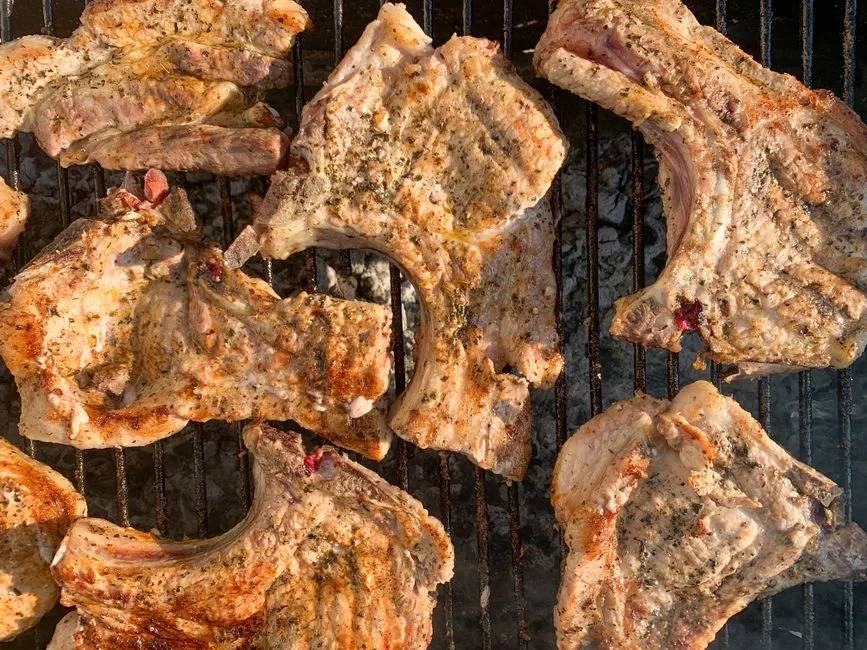
- Pork chop, bone-in or boneless — 63 °C. Probe a thick chop from the side, not down through the top.
- Loin roast or rack of pork — 63 °C, rest around 10 minutes for a larger joint.
- Fresh, uncured leg or ham — 63 °C, rest 10 minutes before carving.
- Pork belly, sliced and braised — 85–90 °C, which is where the fat renders and the meat gives way.
- Belly roast with crackling — around 88 °C internally before the final high-heat blast for the skin.
- Spare ribs and baby back ribs — 90–95 °C, judged together with how the rack bends when lifted.
- Shoulder or Boston butt for pulling — 93–96 °C, and it has to feel probe-tender, not merely read the number.
- Minced pork, sausages, meatballs and pork burgers — 71 °C throughout.
Why Shoulder and Ribs Ignore the 63 °C Rule
A pork shoulder pulled at 63 °C is safe and almost inedible. The difference between the two families of cuts is collagen, the connective tissue that holds hard-working muscle together. As it heats it tightens and squeezes moisture out of the meat, and only past roughly 70 °C does it start converting into gelatin in useful quantities. That conversion is slow, so time spent at temperature does as much work as the temperature itself.
This is why pulled pork is taken to 93–96 °C over many hours rather than rushed. The meat passed the point of being safe to eat many hours earlier; everything after that is purely a texture project, turning tough tissue into something that lubricates the meat instead of binding it.
It also explains the stall that catches out most first-time smokers and slow roasters — a long plateau somewhere around 65–75 °C where the reading simply stops climbing. Nothing is broken. Moisture evaporating from the surface is cooling the meat almost exactly as fast as the heat source is warming it, and the plateau breaks by itself once the surface dries or once the joint is wrapped.
Carryover Heat: Pull Before the Number, Not At It
Meat keeps cooking after it comes off the heat, because the hot outer layer is still driving energy inwards. How much it climbs depends on the size of the cut and on how aggressive the cooking was. A thin tenderloin seared hard in a pan can gain several degrees; a joint that came out of a low oven has a shallow temperature gradient across it and climbs less.
The practical habit is simple: decide the finished temperature you want, subtract the carryover you expect, and pull there. For a chop aimed at 63 °C, that usually means taking it off the heat somewhere around 58–60 °C and letting the rest finish the job. If you wait until the probe reads 63 °C in the pan, you will be eating pork somewhere in the high sixties — which is precisely the dry, chalky result the old advice used to produce.
- Thin, hard-seared cuts: the largest climb — pull several degrees early
- Large roasts from a low oven: a smaller climb — pull two or three degrees early
- Resting under loose foil on a warm plate keeps the climb going; a bare rack shortens it
- Ground pork is not a carryover game: take it to 71 °C and serve it
Taking the Reading So the Number Means Something
Most disagreements about pork temperature are really disagreements about probe placement. The reading has to come from the coldest part of the cut, which is the geometric centre of the thickest section, clear of bone and clear of any large seam of fat — both conduct heat differently from muscle and will lie to you in opposite directions.
Take more than one reading. Move the probe a centimetre or two, read again, and treat the lowest number you find as the true one. An instant-read thermometer needs a few seconds to settle, and the sensor normally sits slightly back from the very tip, so push it properly into the meat rather than touching the surface. Leave-in probes are worth having for long cooks, but it is sensible to confirm a suspicious stall reading against a separate instant-read before making a decision about it.
- Thickest part, centre of the muscle, away from bone and fat seams
- Probe chops and thin cuts horizontally from the side
- Check two or three spots and trust the lowest reading
- Give the display a few seconds to stop moving before you act on it
- Ice water and boiling water are the two free sanity checks on a thermometer you no longer trust
Pink Pork Is Not Undercooked Pork
At 63 °C plus a rest, a pork chop or loin will often show a faint blush of pink through the centre with clear juices. That is what correctly cooked modern pork looks like, and it is the single hardest thing to unlearn for anyone brought up on the higher number.
Colour is an unreliable doneness signal in any case. The pigment that makes meat look pink responds to the pH of the muscle, to how the meat was handled and stored, to whether it was frozen, and to nitrite in anything cured or brined. Cured and brined pork can stay stubbornly pink far past any temperature you would want to eat it at, and smoked pork develops a pink ring at the edge from the smoke itself rather than from being underdone. Meanwhile, some pork goes grey early and looks overcooked while the centre is still where you want it.
The reverse is worth saying plainly too: a chop taken to 71 °C is not safer in any meaningful sense than one held at 63 °C with its rest. It is simply drier. The thermometer is the only part of this process without an opinion — trust it over the colour of the cut face every time.
Frequently Asked Questions
Is 63 °C really safe for pork?
Yes, for whole and intact cuts, provided the reading comes from the thickest part of the meat and the pork rests for three minutes before carving. Safety depends on temperature combined with time held at that temperature, which is why the short rest is part of the target rather than an optional flourish. Ground pork, sausage and mechanically tenderised cuts are the exception and need 71 °C throughout.
What is the pork temperature in Celsius and Fahrenheit?
63 °C is 145 °F, 71 °C is 160 °F, and the pulled-pork window of 93–96 °C is roughly 199–205 °F. A recipe that specifies 145 °F for a chop is describing exactly the same cook as 63 °C, not a lower or riskier one — the two scales are the usual reason people think the guidance has changed when it has not.
Why is my pork still slightly pink at 63 °C?
Because that is what pork looks like at that temperature. Meat pigment is affected by the pH of the muscle, by freezing, by curing salts and by smoke, so a pink centre or a pink ring near the surface says very little about whether the pork is done. Go by the thermometer reading in the thickest part, not by the colour of the slice.
What temperature should pulled pork reach in Celsius?
Somewhere between 93 and 96 °C, and the probe should slide into the meat with almost no resistance. Temperature alone is not a guarantee: two shoulders can both read 94 °C with different amounts of collagen left to break down. If the probe still meets resistance, the shoulder needs more time rather than more heat.
How long should pork rest before carving?
At least three minutes for chops, tenderloin and other whole cuts, and closer to ten minutes for a large roast so the juices redistribute and the carryover heat finishes its work. Ground pork needs no rest at all. A long-cooked shoulder benefits from a considerably longer rest, loosely covered, before you pull it apart.
Related guides